A classroom can be quiet without every student understanding the lesson. Some students may follow every word, while others may struggle with a concept but hesitate to ask questions. Some may participate actively, while others remain silent throughout the class.
For teachers, understanding what happens beyond the visible signs of engagement can be challenging. Eye contact, raised hands and verbal answers offer useful clues, but they do not always show how well students understand a topic.
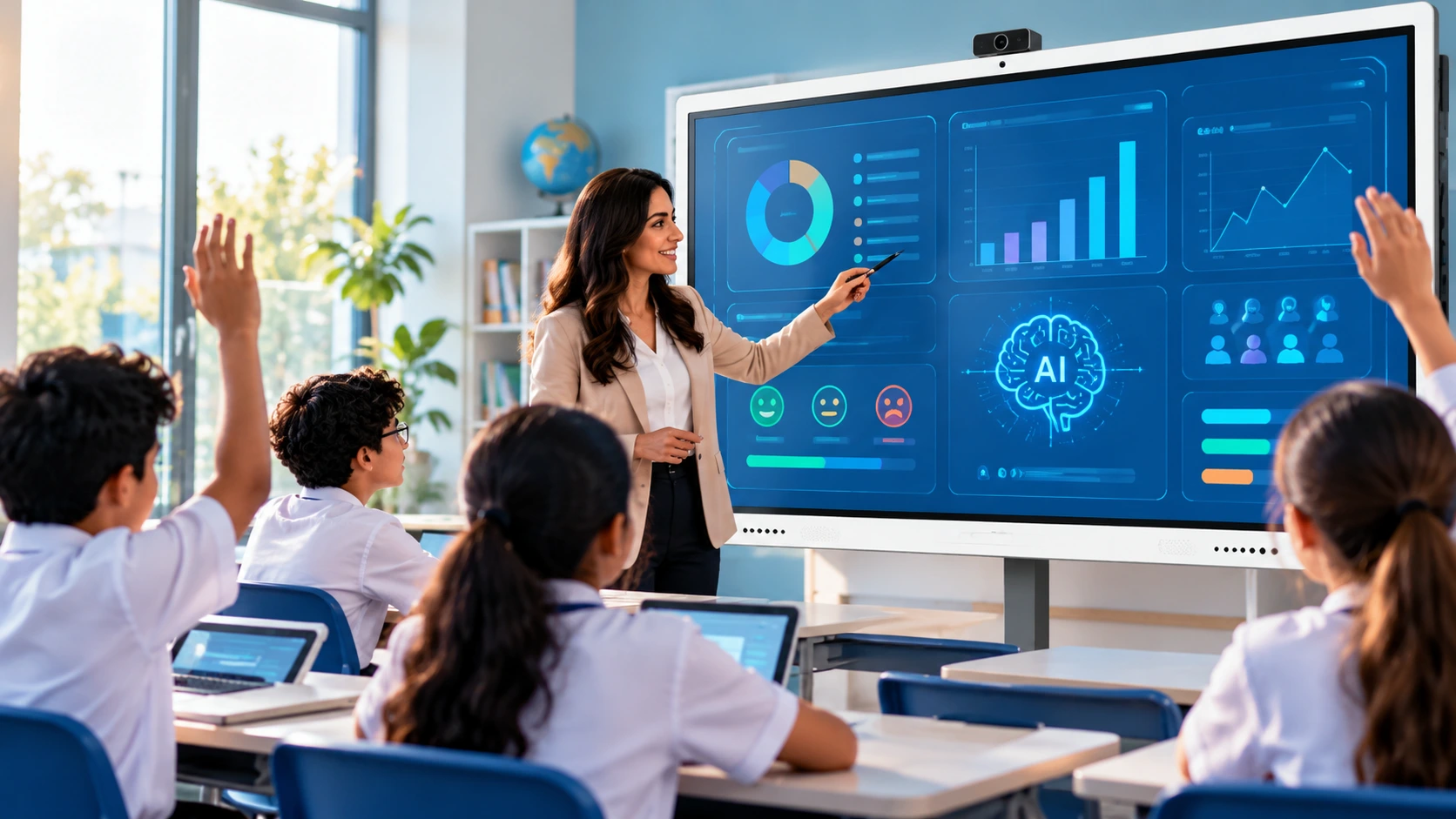
This is where Artificial Intelligence (AI) and Interactive Flat Panels (IFPs) can make a difference. By combining interactive learning tools, real-time assessment and data analytics, AI-enabled classroom technology can help teachers understand student responses, identify learning gaps and make better decisions during lessons.
For schools looking to improve classroom participation, interactive flat panels for schools Dubai, UAE can support more engaging lessons through digital activities, real-time assessments and collaborative learning tools.
1. Moving Beyond Guesswork in the Classroom
Traditional teaching methods often depend on observation and assessments conducted after a lesson. A test may reveal that students have misunderstood a concept, but by then, the class may have already moved to the next topic.
AI-powered learning tools can help teachers identify these gaps earlier through interactive activities and real-time feedback.
For example, a teacher explaining fractions can use a live quiz on an Interactive Flat Panel. If several students select the wrong answer, the response data can highlight a possible misunderstanding. The teacher can revisit the concept before moving forward.
This approach supports data-driven teaching, where classroom decisions are based on student responses rather than observation alone.
However, engagement data should be treated as an additional source of information, not a complete measure of student understanding. A student who answers slowly may be thinking carefully, while a quick response does not always indicate full comprehension.
2. How AI in Interactive Flat Panels Measures Engagement
Interactive Flat Panels bring digital content, touch-based activities and collaborative learning tools into one classroom workspace. When supported by compatible AI software, assessment tools and analytics platforms, they can help teachers collect useful information about classroom participation.
Here are three ways these technologies can support engagement tracking.
Real-Time Formative Assessment
Formative assessment helps teachers check student understanding during the learning process rather than waiting for a final examination.
Using live quizzes, polls, multiple-choice questions and interactive exercises, teachers can collect responses and review the results immediately.
For example, if 30 students answer a question and 12 choose an incorrect option, the teacher can identify that the concept may need further explanation.
The result is a clearer picture of class-wide understanding, allowing lessons to be adjusted when needed.
Multi-User Collaboration Tracking
Modern Interactive Flat Panels support multi-touch interaction, allowing several students to work on the same digital workspace.
During a group activity, students can solve problems, annotate content, arrange diagrams or contribute ideas directly on the panel. Compatible collaboration software may record individual contributions and activity patterns.
This can help teachers review whether group activities encourage participation or whether some students need more opportunities to contribute.
AI-Assisted Learning Analytics
AI-assisted learning analytics can help organise assessment results, identify recurring errors and highlight patterns across multiple activities.
For example, if students repeatedly struggle with the same type of mathematics problem, an analytics tool may help identify the topic that requires additional attention.
These insights can support lesson planning and targeted revision. The exact capabilities depend on the AI software and analytics features available; an Interactive Flat Panel alone does not automatically measure every aspect of student engagement.
3. Key Engagement Metrics Teachers Can Use
Collecting classroom data is only useful when it helps teachers make better teaching decisions. Several metrics can provide practical insights into student participation and understanding.
Response Rate and Accuracy
Response rate shows how many students participate in an activity, while accuracy measures how many responses are correct.
For example, if 27 out of 30 students submit answers to a classroom quiz, the response rate is 90%. If 18 of those students answer correctly, the accuracy rate among respondents is approximately 66.7%.
These figures help teachers distinguish between participation and understanding. A high response rate does not necessarily mean that students have understood the lesson.
Response Time
Response time measures how long students take to answer a question or complete an activity.
Longer response times may indicate that a question is difficult, the instructions are unclear or students need more thinking time. Shorter response times may suggest familiarity with the topic, although speed alone cannot confirm understanding.
When reviewed alongside accuracy and question difficulty, response-time data can help teachers decide whether to explain a concept again or introduce a more challenging activity.
Participation Distribution
Participation distribution shows how contributions are shared across students or groups.
In a traditional classroom discussion, a few confident students may answer most questions. Interactive quizzes and collaborative digital activities can give more students an opportunity to participate.
Where compatible software records individual contributions, teachers can review participation patterns and identify students who may benefit from more encouragement.
These insights can help create a more inclusive learning environment without labelling quiet students as disengaged.
4. Using Engagement Data to Improve Lessons
The real value of classroom analytics lies in how teachers use the information during a lesson.
Consider a science class learning about the human digestive system. The teacher uses an Interactive Flat Panel to display a labelled diagram and launches a short quiz to check understanding.
The results show that many students have confused the functions of the small intestine and the large intestine.
Instead of continuing to the next topic, the teacher can return to the diagram, use an animation to explain the differences and ask students to complete a quick matching activity.
A second quiz can then check whether understanding has improved.
This creates a simple teaching cycle:
Assess → Analyse → Explain → Reassess
AI-assisted tools can support this process by organising results, identifying recurring mistakes and suggesting relevant learning resources where those features are available.
Over time, teachers can also compare assessment results across lessons to identify topics that consistently require more attention. This information can support better lesson pacing, revision planning and differentiated instruction.
5. Supporting More Inclusive Classrooms
Classroom engagement does not look the same for every student. Some learners prefer speaking, while others express their understanding through writing, drawing, problem-solving or individual activities. Interactive flat panels for schools Dubai, UAE can support these different learning preferences by offering interactive exercises, digital polls, shared workspaces and visual learning resources.
Interactive Flat Panels provide different ways to participate. Students can annotate diagrams, solve problems on the screen, respond to digital polls or collaborate on shared tasks.
When combined with accessible content and suitable learning software, these features can offer more opportunities for students with different learning preferences.
Teachers can also use assessment data to identify students who may need additional explanations, simpler examples or more challenging tasks.
The aim is not to make every student participate in the same way. It is to provide meaningful opportunities for everyone to engage with the lesson.
6. Data Privacy and Responsible Use of AI
Although AI-powered classroom technology offers useful insights, student privacy must remain a priority.
Schools should understand what information their platforms collect, how long it is stored, who can access it and whether it is shared with third parties. Data collection should be limited to what is necessary for educational purposes.
Teachers should also avoid treating AI-generated results as final judgements about a student’s ability, attention or behaviour. Classroom analytics can highlight patterns, but they cannot fully explain why a student is quiet, distracted or struggling.
Human observation, teacher-student communication and professional judgement remain essential.
When used responsibly, AI can reduce the time spent organising assessment results and give teachers more time to focus on individual learning needs.
Conclusion: Better Classroom Insights, Better Teaching Decisions
Understanding classroom engagement requires more than counting raised hands or checking examination scores. Teachers need practical ways to see how students respond, where they struggle and which teaching methods help them learn.
AI-enabled Interactive Flat Panels, supported by compatible assessment tools and learning analytics, can provide useful insights through real-time feedback, response accuracy, participation patterns and recurring learning gaps.
The benefits depend on the quality of the software, the relevance of the data and how effectively teachers use the results.
Technology cannot replace the human connection at the heart of education. However, when combined with thoughtful teaching, it can help educators make more informed decisions, respond to learning needs earlier and create classrooms where more students have the opportunity to participate and succeed.