Think about your business for a moment.
Who is watching the entrance? What happens in the parking area? Can your security team clearly see what is happening at the other end of the warehouse? And when something unusual happens, can your cameras actually follow it?
In Dubai’s busy business environment, simply having CCTV cameras is no longer enough. Businesses need surveillance that can see more, respond faster, and cover more ground.
And that brings us to an important question: “Should you choose a fixed CCTV camera or a PTZ camera?”
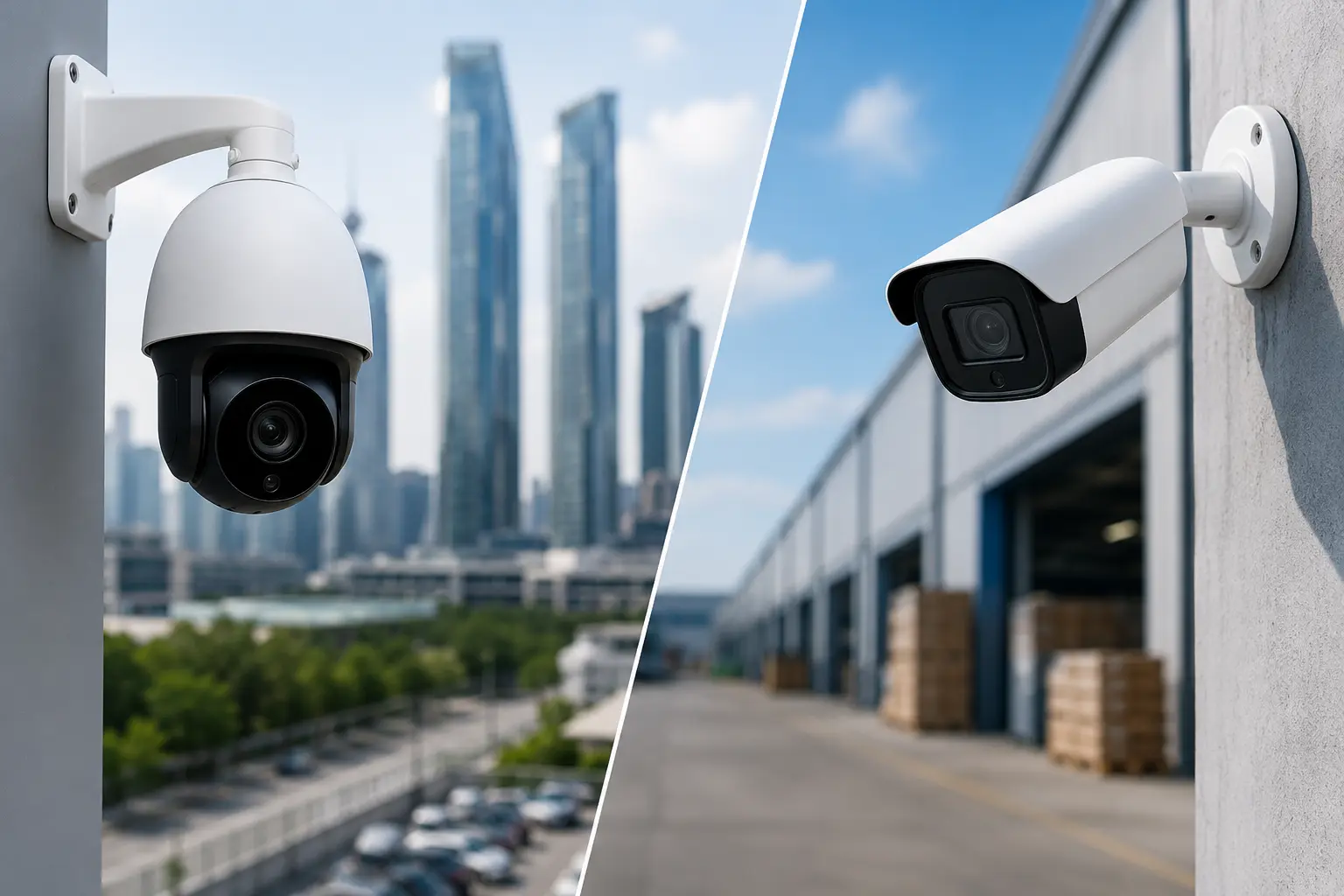
Two common options businesses consider are fixed CCTV cameras and Pan-Tilt-Zoom (PTZ) cameras. Both have their place in a security system, but they work very differently.
A fixed camera watches one specific area from one fixed angle. A PTZ camera, on the other hand, can move from side to side, up and down, and zoom in on objects that are far away.
For businesses managing large or busy spaces, this flexibility can make PTZ cameras a more practical choice.
Fixed CCTV vs. PTZ Cameras: What Is the Difference?
The simplest way to understand the difference is to think about where each camera is looking.
A fixed CCTV camera is installed to monitor a particular area. Once it is positioned, it continues watching that same direction. This makes it useful for places such as entrances, reception areas, corridors, counters, or small rooms where the area of interest does not change.
A PTZ camera is much more flexible. PTZ stands for Pan, Tilt, and Zoom.
- Pan allows the camera to move horizontally.
- Tilt allows it to move vertically.
- Zoom allows it to bring distant objects closer for better viewing.
This means one PTZ camera can monitor different parts of a large area instead of being limited to one fixed view.
PTZ vs. Fixed CCTV: A Quick Comparison
| Security Feature | Fixed CCTV Camera | PTZ Camera |
| Viewing angle | Fixed | Can move horizontally and vertically |
| Wide-area monitoring | Limited | Excellent |
| Remote movement | No | Yes |
| Optical zoom | Usually limited | Available on many models |
| Tracking moving subjects | Limited | Available with compatible AI features |
| Large-area coverage | Often needs multiple cameras | Can cover a wider area with fewer units |
| Best suited for | Entrances, rooms, counters | Warehouses, parking areas, campuses, large commercial spaces |
The right choice ultimately depends on the size and security requirements of the property. However, for businesses with large or constantly changing areas, PTZ cameras offer several important advantages.
Why Are PTZ camera in Dubai, UAE a Good Choice for Businesses?
Dubai has a wide range of commercial properties. A small retail outlet and a large logistics facility obviously do not have the same surveillance requirements.
A camera that works well for a small entrance may not be enough for a large warehouse or parking area.
Here are some of the reasons PTZ cameras are becoming an attractive option for businesses that need wider and more flexible surveillance.
1. Cover More of a Large Area
One of the biggest advantages of a PTZ camera is its ability to look in different directions.
Consider a large warehouse with multiple storage sections. A fixed camera installed in one corner can continuously monitor only the area within its field of view. To cover the remaining areas, additional cameras may be required.
A PTZ camera can move across a much wider area. Security personnel can control its viewing direction remotely, allowing them to check different sections when needed.
This can be particularly useful in:
- Warehouses and logistics facilities
- Large parking areas
- Construction sites
- School and university campuses
- Meeting Rooms & Training centres
- Hotels and resorts
- Retail and shopping spaces
- Industrial facilities
- Large office compounds
Instead of having every camera permanently focused on one small area, PTZ cameras can provide greater flexibility across open spaces.
2. Get a Closer Look When It Matters
Seeing that something happened is useful. Being able to clearly see what happened can be even more important.
Imagine a security team notices unusual activity at the other end of a parking area. With a basic fixed camera, the person or vehicle may appear too small to identify properly.
A PTZ camera with optical zoom can move toward the area and zoom in on the subject.
This can help security teams get a clearer view of details such as:
- Faces
- Vehicle numbers
- Entry and exit activity
- Packages and deliveries
- People moving around restricted areas
- Activities taking place at a distance
The important point is the optical zoom. Unlike digital zoom, optical zoom uses the camera’s lens to bring an object closer while maintaining much better image quality.
Depending on the model, professional PTZ cameras can offer high levels of optical zoom, including 10x, 20x, or even 30x.
3. Follow Moving Activity
A fixed camera does not follow a person who walks outside its viewing area.
PTZ cameras can offer a different approach.
When combined with suitable AI analytics and auto-tracking capabilities, a PTZ camera can detect movement and follow a person or vehicle as it moves through the monitored area.
For example, if someone enters a restricted section of a warehouse, an AI-enabled PTZ camera may be able to track that movement and keep the subject within view.
This can be particularly helpful for businesses where movement happens continuously and security teams cannot manually watch every camera feed all the time.
4. Remote Control Gives Security Teams More Flexibility
Another useful feature of PTZ cameras is remote control.
Security personnel can change the camera’s direction using a controller or compatible software. They do not necessarily need to be physically present near the camera.
For example, if a security officer notices something unusual on one side of a property, the PTZ camera can be directed toward that location.
This flexibility can make a difference when security teams need to respond quickly to an unexpected situation.
5. Fewer Cameras May Be Needed in Some Open Areas
PTZ cameras generally cost more than basic fixed cameras. So, at first glance, they may not appear to be the cheaper option.
However, the initial camera price is only one part of the overall cost of a surveillance system.
Large properties may require several fixed cameras to cover different viewing angles. More cameras can also mean more cabling, installation work, network connections, and maintenance.
A strategically placed PTZ camera can cover a large open area and reduce the number of cameras required in certain locations.
That does not mean one PTZ camera can replace every fixed camera. Rather, the two can work together to create a more efficient surveillance system.
6. A Better Fit for Dynamic Business Environments
Business environments are not always static.
People enter and leave. Vehicles move around. Deliveries arrive. Employees move between different sections. Customer traffic changes throughout the day.
A fixed camera continues watching the same location regardless of what is happening elsewhere.
A PTZ camera provides the flexibility to respond to these changes.
For businesses with constantly changing activity, this ability to move and focus on different areas can make surveillance more useful.
Where Can PTZ Cameras Be Used in Dubai?
PTZ cameras can be useful across many types of commercial properties.
Meeting Rooms and Conference Rooms
Modern meeting rooms often involve presentations, discussions, training sessions, and video conferences. A PTZ camera can capture different parts of the room and focus on the person speaking or presenting.
With remote control and auto-tracking features, it can also make hybrid meetings and video conferences more convenient by keeping the speaker in view without requiring a dedicated camera operator.
Coaching Centres and Training Institutes
Coaching centres often have classrooms where teachers move between the board, students, and different areas of the room. A PTZ camera can provide a wider view of the classroom and zoom in on the teacher, whiteboard, or a particular activity when required.
It can also be useful for recording lessons, supporting remote learning, and monitoring larger training spaces.
Schools and Educational Campuses
Schools can have multiple areas that need surveillance, including classrooms, corridors, entrances, playgrounds, assembly areas, and parking spaces.
PTZ cameras can help monitor larger common areas and outdoor spaces, while fixed cameras can be positioned at specific points such as entrances and corridors. This combination can provide schools with broader and more flexible coverage.
Warehouses and Logistics Centres
Large warehouses often include storage areas, loading bays, entrances, and vehicle movement. A PTZ camera can cover a wide section of the facility and zoom in when security teams need a closer look at a person, vehicle, or specific activity.
Parking Facilities
Large parking areas can be challenging to monitor with fixed cameras alone. PTZ cameras can scan different sections and zoom in on vehicles or activity when something requires closer attention.
Hotels and Resorts
Hotels have several areas that require monitoring, including entrances, driveways, parking facilities, outdoor spaces, and service areas. PTZ cameras can provide flexible coverage across these locations.
Retail and Commercial Properties
Shopping spaces, showrooms, and large commercial buildings experience continuous customer and employee movement. PTZ cameras can help security teams monitor wider areas and focus on specific activity when needed.
Construction Sites
Construction sites can cover large areas and may contain expensive equipment, vehicles, and materials. PTZ cameras can provide wide-area monitoring and allow security teams to focus on different sections of the site remotely.
Offices and Corporate Facilities
Beyond meeting rooms, PTZ cameras can be useful in large office environments, reception areas, training rooms, and shared spaces where activity changes throughout the day.
For businesses and institutions in Dubai, the key advantage of PTZ technology is its flexibility. Instead of being limited to one fixed viewing angle, the camera can move, focus, and zoom according to what is happening in the environment.
What Should Dubai Businesses Consider Before Choosing a PTZ Camera?
Buying a PTZ camera simply because it has a high zoom number is not enough. Businesses should consider their actual security requirements.
Look at factors such as:
- Camera resolution
- Optical zoom capability
- Pan and tilt range
- Night vision performance
- AI detection and tracking features
- Network connectivity
- Integration with the existing surveillance system
- Installation location
- Compliance with applicable Dubai security requirements
Businesses should also make sure their surveillance solution meets the requirements applicable to their property and the relevant local authorities.
PTZ Cameras and the Future of Business Security
Modern surveillance is moving beyond simply recording footage.
Businesses increasingly want cameras that can help them understand what is happening, identify unusual activity, and respond more quickly.
This is where technologies such as AI detection, auto-tracking, remote monitoring, and high optical zoom can add value.
A PTZ camera combines many of these capabilities into one flexible surveillance solution.
However, technology alone does not guarantee security. Camera placement, network infrastructure, storage, monitoring practices, and professional installation all play an important role.
Conclusion
There is no single CCTV camera that is perfect for every business.
Fixed cameras remain a practical option for monitoring specific locations continuously. But when a business needs to monitor large open spaces, follow movement, zoom in on distant activity, or remotely change the camera’s viewing direction, PTZ camera in Dubai, UAE offers a significant advantage.
For businesses operating warehouses, meeting rooms, parking facilities, commercial properties, hotels, campuses, and other large spaces, PTZ camera in Dubai, UAE can provide the flexibility and coverage needed for a modern surveillance system.
The smartest approach is not always choosing PTZ over fixed cameras. It is understanding the property and using the right combination of technologies to create responsive security.